
Post-Tension Slab Leak Repair in Las Vegas: Spot Repair vs. Overhead PEX Re-Route
Compare surgical slab spot repairs vs. overhead PEX-A rerouting for Las Vegas post-tension concrete foundations and aging copper manifolds.
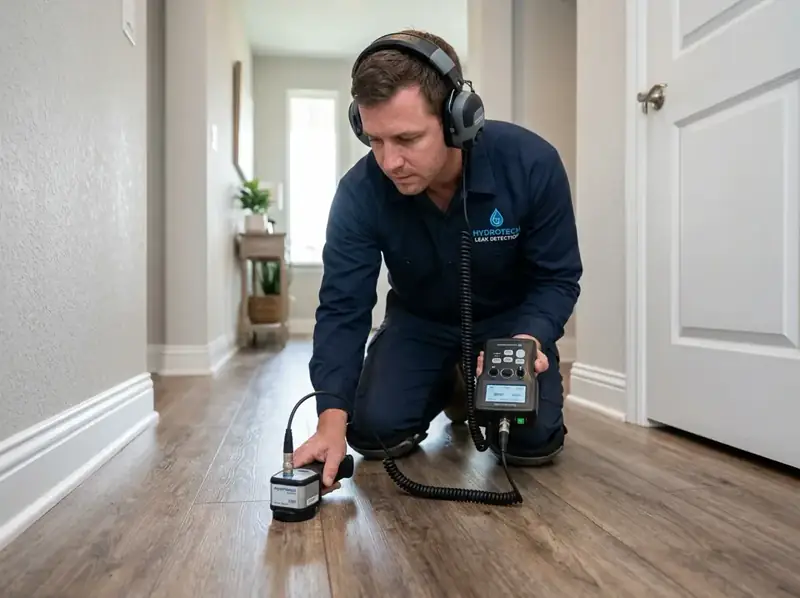
Why Cutting Blindly Into a Las Vegas Post-Tension Slab Is Dangerous
Post-tension slabs contain grease-sheathed steel tendons stressed to roughly 33,000 pounds of force. Nicking or severing a live tendon during exploratory jackhammering compromises structural foundation tension and creates severe jobsite safety hazards.
Even when a slab contains standard rebar, tearing out porcelain tile, natural travertine, or engineered hardwood adds thousands in restoration bills. That is why every slab leak repair in Las Vegas starts with non-invasive ultrasonic acoustic localization and FLIR thermal imaging to mark the break within a 6-to-12-inch zone before any concrete work is considered.
- Post-tension tendons must be avoided or scanned before concrete saw-cutting
- Acoustic + thermal pinpointing eliminates guesswork floor demolition
Option 1: Direct Surgical Spot Repair Through the Slab
During a direct spot repair, an NSCB-licensed plumber opens one small concrete patch directly above the acoustically marked pinhole, removes the corroded 12-to-24-inch copper section, and brazes in sleeved Type-L copper.
Spot repairs work best when the property is relatively new, the failure resulted from an isolated installation nick or sharp caliche contact, and you have spare matching flooring tile on hand.
- Lower upfront cost when only a single isolated copper elbow has failed
- Fastest same-day restoration for accessible garage or utility-closet breaks
- Does not replace other aging under-slab copper segments experiencing hard-water pitting
Option 2: Overhead PEX-A Re-Route (Bypassing the Slab Permanently)
When a Las Vegas home built between 1985 and 2005 suffers its first or second hot-water copper slab leak, internal mineral erosion and desert caliche abrasion usually mean neighboring under-slab runs are already thinning.
An overhead PEX re-route permanently caps both ends of the leaking subterranean pipe and threads flexible, freeze-and-scale-resistant PEX-A tubing through attic chases and interior drywall cavities. No concrete jackhammering is required, post-tension cables stay untouched, and future caliche friction beneath the slab is eliminated forever.
- Zero concrete cutting or post-tension cable risk
- Eliminates future sub-slab copper corrosion in hard Las Vegas water
- Pairs seamlessly with PRV replacement to keep static pressure under 60–75 PSI
Check Your PRV (Pressure Reducing Valve) After Any Slab Leak
Foothill neighborhoods in Northwest Las Vegas (89129), Centennial Hills, and Summerlin South frequently see street main pressures above 80–110 PSI. When a failing brass PRV lets street pressure surge into your home, hot-water copper loops endure extreme velocity erosion.
Testing static water pressure at a front hose bib after every slab leak repair ensures your home stays within Clark County / City of Las Vegas code (under 80 PSI, ideally 55–65 PSI).
Frequently Asked Questions
Which is better in Las Vegas: a slab spot repair or an overhead PEX reroute?
If your home has aging copper pipes from the 1980s–2000s or has already had a prior slab leak, an overhead PEX-A reroute is usually the smarter long-term investment because it removes piping from corrosive desert caliche soil permanently.
How do technicians avoid hitting post-tension cables when opening a slab?
Licensed contractors locate slab stamp markings, trace cable spacing, use concrete scanning tools when needed, and isolate the leak within inches using acoustic sensors—or bypass the slab altogether with an overhead PEX reroute.
Can I still qualify for an LVVWD 50% leak credit if I choose a PEX reroute?
Yes. As long as the failed sub-slab pipe is permanently abandoned/capped off and documented on an NSCB-licensed contractor invoice with post-repair meter verification, LVVWD accepts both spot repairs and reroutes for leak credit review.
How long does an overhead single-line PEX reroute take?
Most single-line hot or cold slab reroutes in Las Vegas are completed in one day, leaving only minimal small drywall access points rather than torn-up tile floors.
Suspect a sub-slab leak under your Las Vegas home? Call Las Vegas Leak Detection Services 24/7 at (725) 313-0108 from our 3320 N Pioneer Way, Las Vegas, NV 89129 dispatch desk for non-invasive acoustic isolation and upfront spot-repair vs. PEX reroute comparisons.
Explore More Diagnostic & Prevention Guides
Recommended reading from our leak detection specialists serving Las Vegas, NV: